Cascode Amplifiers#

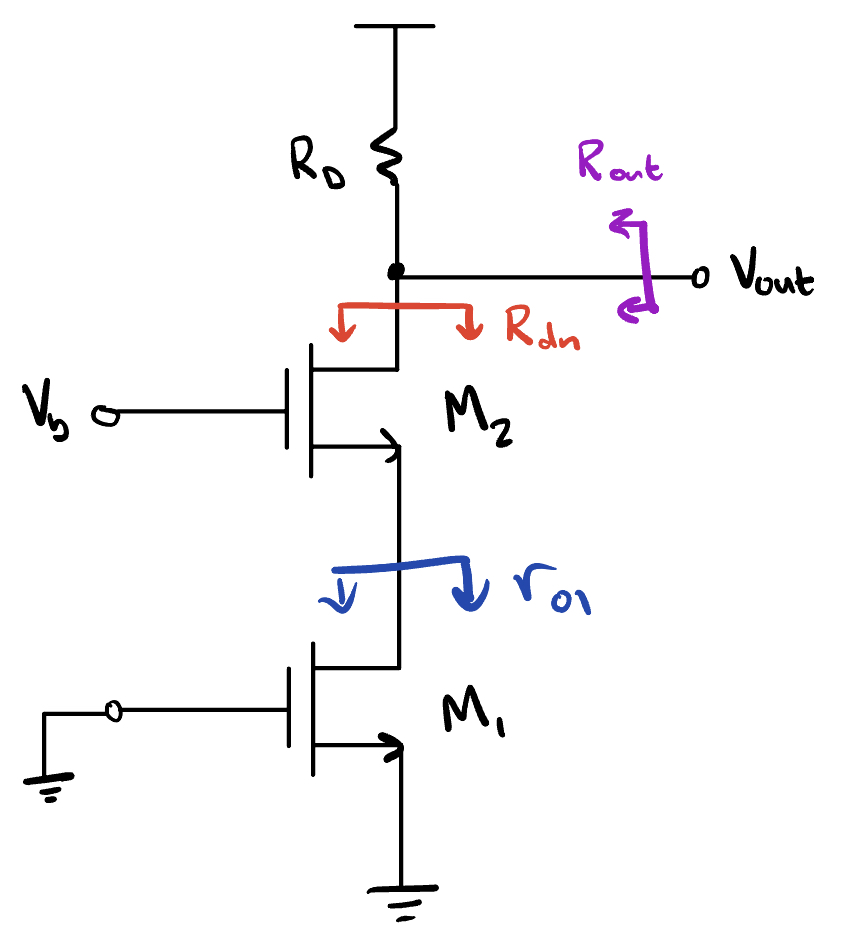
Cascode amplifiers are where MOSFETs are stacked on top of each other.

Cascode Amplifiers#

Large-signal behavior#

We know that \(A = -G_m R_{\text{out}}\).
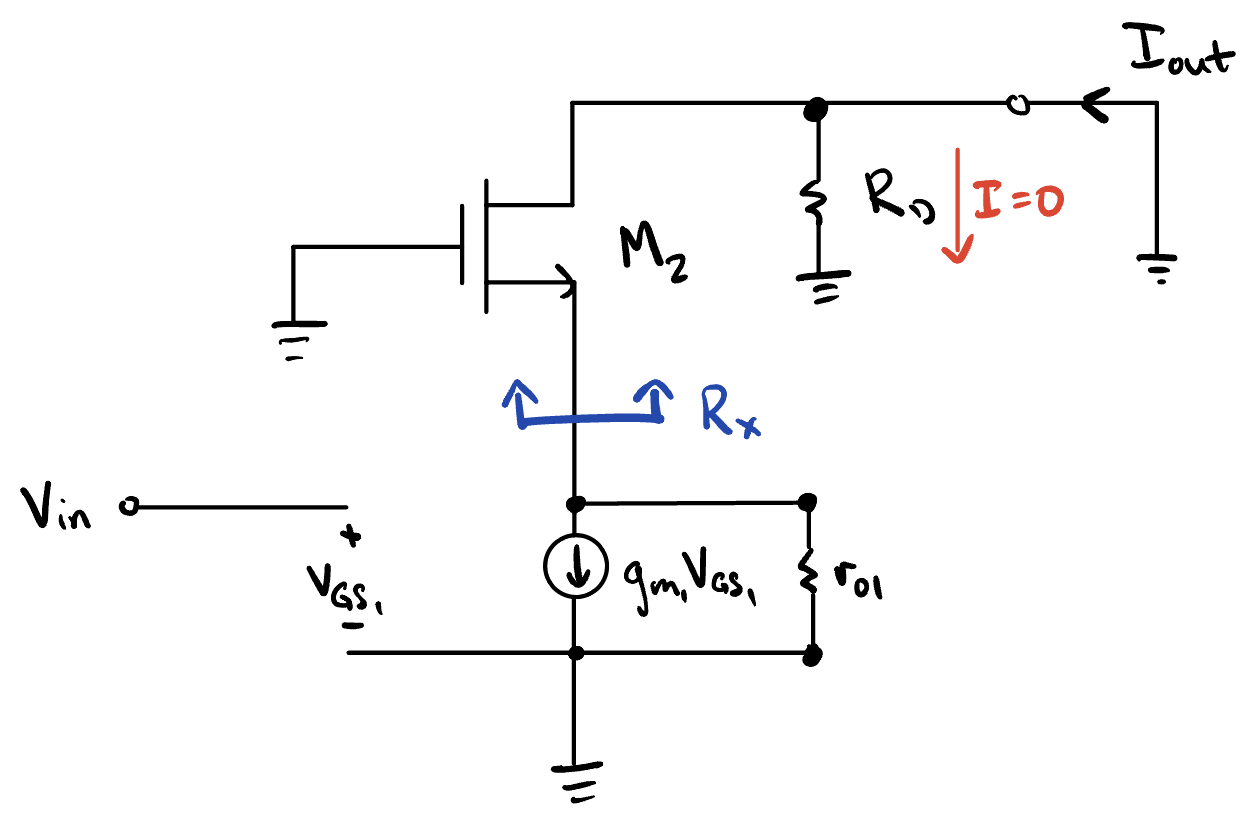
../_images/fig41.jpg

Fig. 48 Small-signal gain.#

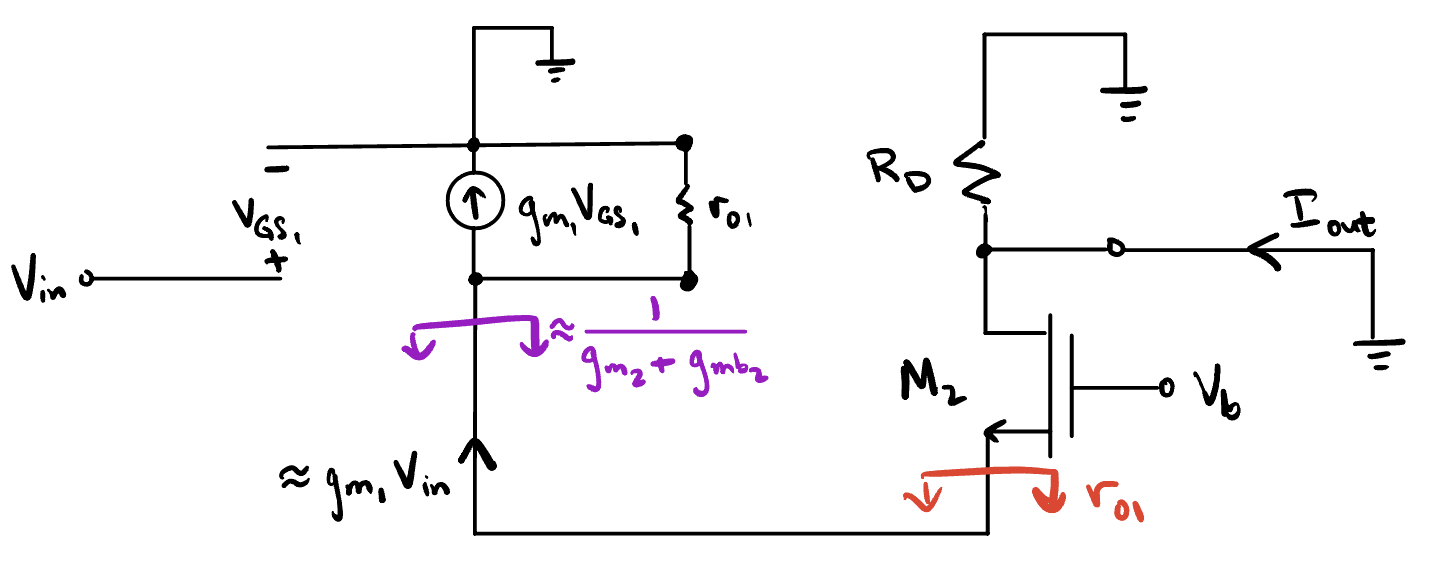
\[ I_x = g_{m_1} V_{\text{in}} \frac{r_{o1}}{r_{o1} + R_x} \]
\[ R_x \approxeq \frac{1}{g_{m_2} + g_{mb_2}} \ll r_{o1} \]

which we know from the common gate topology. Knowing that, \(I_x\) can be reduced to

\[ I_x \approxeq g_{m_1} V_{\text{in}} \]

and

\[ G_m = \frac{I_x}{V_{\text{in}}} = g_{m_1} \]

Impedance#

../_images/fig42.jpg

Fig. 49 Equivalent impedances.#

\[\begin{split} R_{\text{dn}} &= r_{o2} + r_{o1} + (g_{m_2} + g_{mb_2}) r_{o2} r_{o1} \\ &\approxeq (g_{m_2} + g_{mb_2}) r_{o2} r_{o1} \end{split}\]

The output resistance is therefore

\[ R_{\text{out}} = R_D || R_{\text{dn}} \]

Small-signal gain#

The gain is given by

\[ A = - G_m R_{\text{out}} \approxeq -g_{m_1} \left[ (g_{m_2} + g_{mb_2}) r_{o2} r_{o1} || R_D \right] \]

If \(R_D\) is made large, the cascode can have greater gain than some other amplifiers. If \(R_D = \infty\), then

\[ A = -g_{m_1} r_{o1} (g_{m_2} + g_{mb_2}) r_{o2} \]

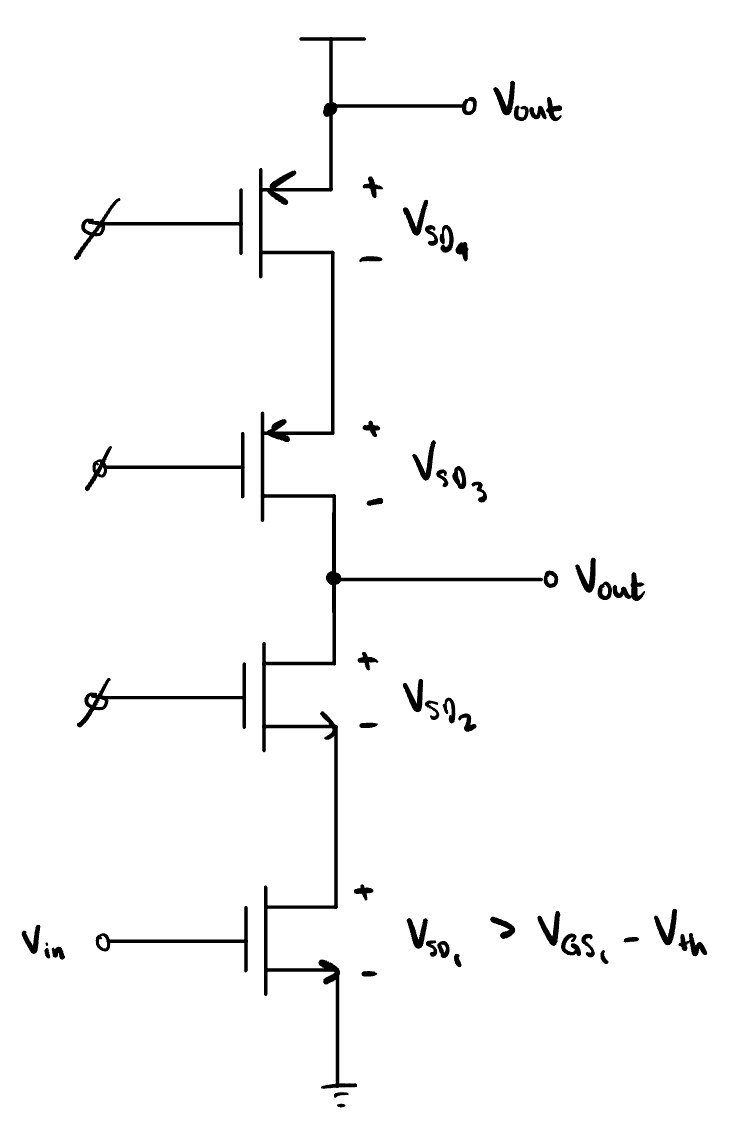
The typical cascode implementation is shown below.
../_images/fig43.jpg

Fig. 50 Typical cascode implementation.#

With a cascode, the output swing is limited. All MOSFETs must be in saturation, and the max output swing is

\[ V_{\text{max swing}} = V_{\text{DD}} - V_{\text{DS}_1} - V_{\text{DS}_2} - V_{\text{DS}_3} - V_{\text{DS}_4} \]

or, what’s left over after all MOSFETs are biased to saturation.

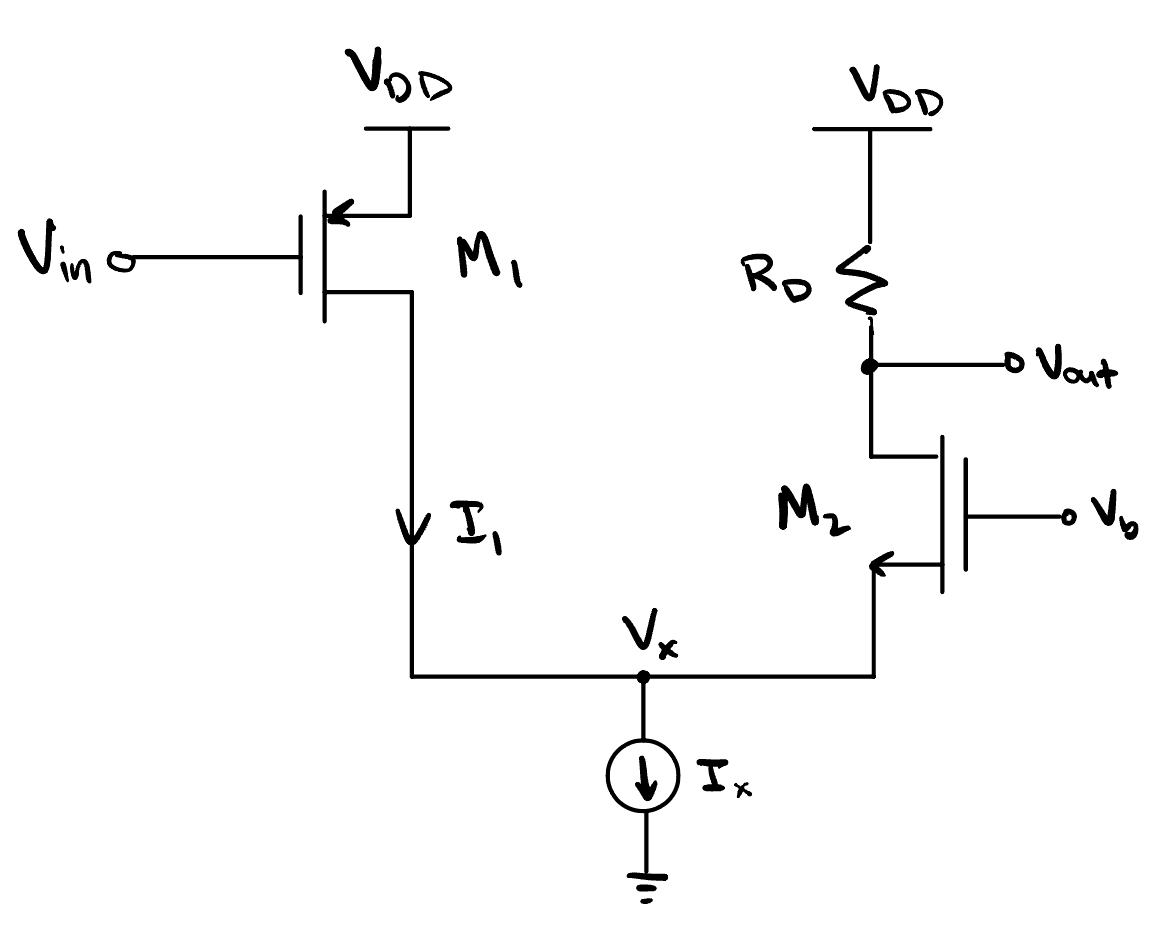
Folded Cascode#
../_images/fig44.jpg

Fig. 51 Folded cascode circuit diagram. Note the MOSFET on the left is a PMOS, while on the right is an NMOS.#

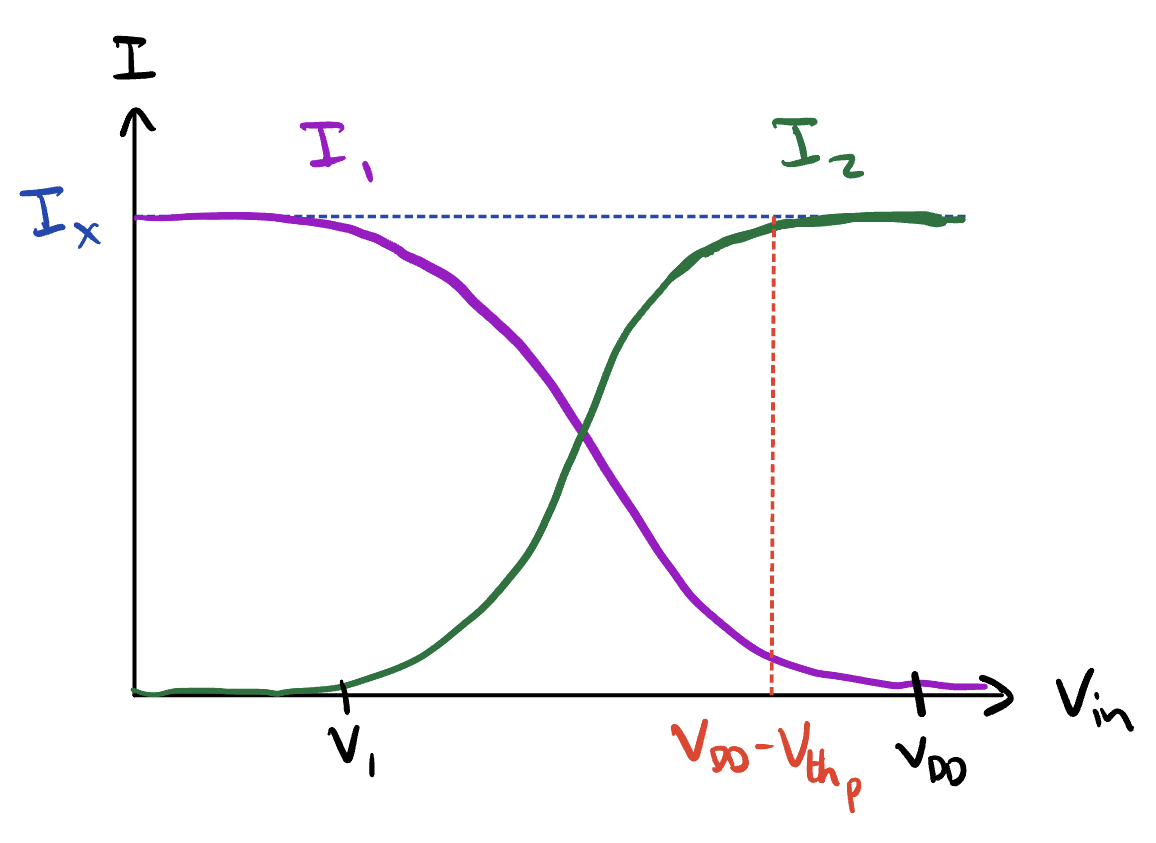
Large-signal behavior#
../_images/fig45.jpg

Fig. 52 Large-signal behavior.#

\[ I_1 = \frac{1}{2} \mu_p c_{\text{ox}_p} \left( \frac{W}{L} \right)_1 (V_{SG_1} - V_{\text{th}_p})^2 \]
images/fig46.jpg

Fig. 53 Output voltage relative to input voltage.#

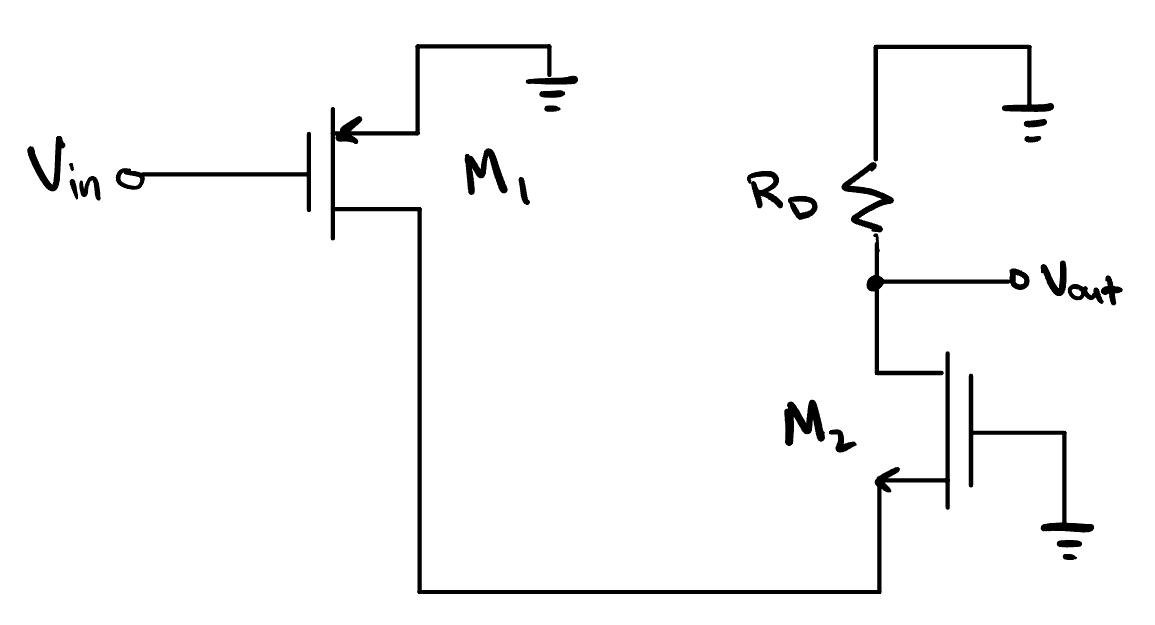
Small-signal gain#
../_images/fig47.jpg

Fig. 54 Small-signal gain.#

../_images/fig48.jpg

Fig. 55 Small-signal circuit model. Note the similarities it shares with the cascode model.#

\[ G_m = \frac{I_{\text{out}}}{V_{\text{in}}} \approxeq g_{m_1} \]
\[\begin{split} R_{\text{out}} &= \left[ r_{o1} + r_{o2} + (g_{m_2} + g_{mb_2}) r_{o2} r_{o1} \right] || R_D \\ &\approxeq (g_{m_2} + g_{mb_2}) r_{o2} r_{o1} || R_D \end{split}\]

And the gain is

\[ A = G_m R_{\text{out}} = -g_{m_1} \left[ (g_{m_2} + g_{mb_2}) r_{o2} r_{o1} || R_D \right] \]

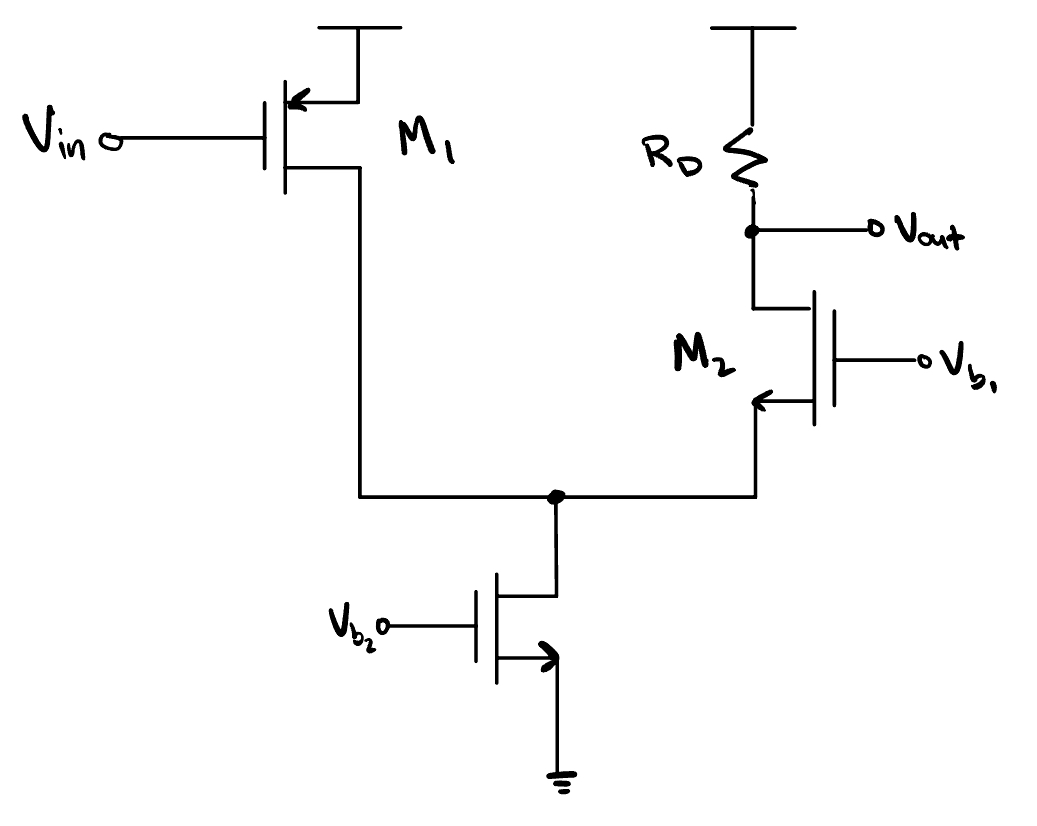
Exercise

Find the gain in the following circuit.

../_images/fig49.jpg

Fig. 56 Sample problem.#